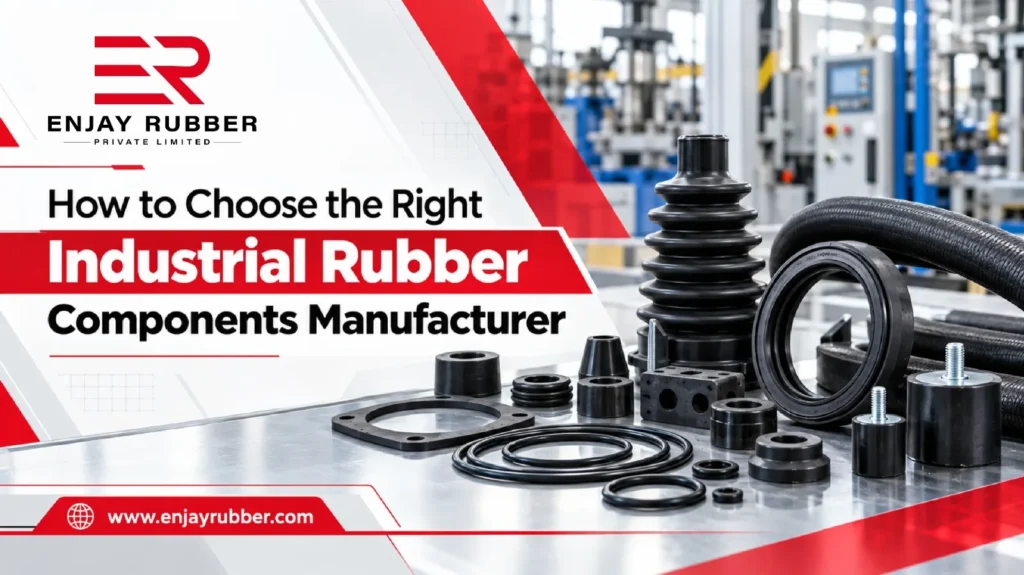
Industrial rubber components play a crucial role in manufacturing, automotive, engineering, fluid handling, and other industrial applications. From sealing and vibration control to insulation and protection, the quality of rubber components directly influences equipment performance, operational reliability, and maintenance costs.
Choosing the right industrial rubber components manufacturer is therefore an important decision for procurement teams, OEMs, and engineering professionals. The right manufacturing partner can help ensure consistent product quality, reliable deliveries, application-specific solutions, and long-term value.
But with several suppliers offering different materials, manufacturing processes, and pricing structures, how can you identify the right partner for your business?
Here are seven important factors to consider before making your decision.
1. Evaluate Material Knowledge and Expertise
Not all rubber materials offer the same properties. The right material depends on the operating environment, temperature, pressure, chemical exposure, flexibility requirements, and intended application.
Common industrial rubber materials include:
- EPDM: Often selected for weather, ozone, and moisture resistance.
- NBR (Nitrile Rubber): Commonly used where oil and fuel resistance is required.
- Silicone Rubber: Suitable for applications requiring flexibility across a broad temperature range.
- Natural Rubber: Frequently used for applications requiring elasticity and abrasion resistance.
- Neoprene: Used in applications requiring a combination of weathering, oil, and general-purpose resistance.
When evaluating an industrial rubber components manufacturer, ask whether the supplier can help identify a suitable material based on your technical requirements.
The correct material selection can improve component life, reduce premature failures, and support reliable equipment operation.
2. Check Manufacturing Capabilities
A manufacturer’s production capabilities should align with your component design, dimensions, tolerances, and order volumes.
Depending on your requirements, relevant capabilities may include rubber moulding, compression moulding, injection moulding, transfer moulding, or rubber extrusion.
Before finalizing a supplier, consider:
- Ability to manufacture custom rubber components.
- Availability of suitable tooling and moulds.
- Capability to meet specified dimensions and tolerances.
- Flexibility to handle prototype and production requirements.
- Capacity to support repeat orders and changing demand.
For OEMs and industrial buyers, selecting a manufacturer with the appropriate production capabilities can simplify sourcing and improve consistency across batches.
3. Assess Quality Control and Testing Procedures
Consistent quality is essential when rubber components are used in machinery, sealing systems, and critical industrial equipment. Variations in hardness, dimensions, material composition, or curing can affect product performance.
A reliable supplier should have a defined quality control process appropriate to the product and application.
Ask potential manufacturers about their inspection and testing procedures, including:
- Dimensional inspection.
- Hardness testing, where applicable.
- Tensile strength and elongation testing, where required.
- Compression set testing for relevant sealing applications.
- Material traceability and batch identification, where required.
- Inspection documentation and procedures for handling non-conforming products.
You should also verify relevant quality certifications and ensure they apply to the manufacturing facility and product scope being evaluated.
A structured quality process helps procurement teams reduce uncertainty, improve repeatability, and manage supplier performance more effectively.
4. Look for Customization and Engineering Support
Standard components may not always meet the specific requirements of industrial equipment. Custom rubber components can be necessary when a design requires particular dimensions, material properties, shapes, or performance characteristics.
When choosing a custom rubber components manufacturer, evaluate whether the supplier can work with your technical drawings, samples, specifications, and application requirements.
Important considerations include:
- Support for custom dimensions and component designs.
- Material recommendations based on operating conditions.
- Assistance with prototype development, where available.
- Coordination on tooling and design feasibility.
- Ability to incorporate approved design changes.
Early communication between the buyer, design team, and manufacturer can help identify potential manufacturing issues before production begins.
This can reduce unnecessary revisions, improve component fit, and support smoother product development.
5. Compare Pricing Beyond the Unit Cost
Price is an important procurement consideration, but the lowest quotation does not always represent the lowest overall cost.
When comparing industrial rubber component suppliers, assess the total cost of sourcing, including tooling, sampling, inspection, transportation, packaging, minimum order quantities, and potential rejection or replacement costs.
Consider the following questions:
- Does the quotation clearly define the material and specifications?
- Are tooling and development charges included?
- What are the minimum order quantities?
- Are inspection documents or special tests charged separately?
- Can the supplier maintain consistent quality across repeat orders?
- Are lead times and delivery terms clearly stated?
A transparent quotation makes it easier to compare suppliers on an equivalent basis.
The objective should be to achieve the right balance between product quality, technical suitability, delivery reliability, and overall procurement cost.
6. Verify Production Capacity and Delivery Reliability
Delays in rubber component supply can interrupt assembly schedules, maintenance activities, and customer deliveries. A manufacturer’s production capacity and planning processes should therefore match your demand requirements.
Before placing an order, discuss expected lead times, production schedules, inventory arrangements, and the supplier’s ability to manage recurring demand.
For procurement teams, useful questions include:
- What is the standard lead time for samples and production orders?
- Can the manufacturer accommodate urgent or repeat orders?
- How are production delays communicated?
- What contingency arrangements exist for unexpected supply disruptions?
- Can the supplier support forecast-based purchasing?
Evaluate delivery performance using actual order history or agreed performance indicators wherever possible.
A supplier that communicates clearly and plans production effectively can help reduce supply-chain uncertainty.
7. Review Communication and Long-Term Partnership Potential
A strong manufacturing relationship goes beyond placing purchase orders. Clear communication, responsive support, and effective issue resolution are important when specifications change or production challenges arise.
Evaluate how the manufacturer handles technical queries, quotation requests, sample approvals, quality concerns, and corrective actions.
A dependable supplier should establish clear expectations regarding specifications, acceptance criteria, delivery schedules, and responsibilities.
For businesses with recurring requirements, a long-term manufacturing partnership can improve planning, streamline procurement, and create opportunities for process improvement.
Checklist Before Finalizing an Industrial Rubber Components Manufacturer
Use this checklist to compare shortlisted suppliers:
- Material expertise matches the intended application.
- Manufacturing processes suit the component design.
- Quality control and testing requirements are clearly defined.
- Customization and engineering support are available where needed.
- Pricing, tooling charges, and order quantities are transparent.
- Production capacity and delivery commitments meet your needs.
- Communication and corrective-action procedures are established.
- Relevant certifications and technical documents have been verified.
Comparing manufacturers against the same checklist helps procurement teams make a more informed and objective decision.
Conclusion
Choosing the right industrial rubber components manufacturer requires more than comparing quotations. Material expertise, manufacturing capabilities, quality assurance, customization, delivery performance, and technical support all influence the long-term value of a supplier.
By evaluating these factors before placing an order, procurement teams and OEMs can reduce sourcing risks, improve component consistency, and build stronger supplier relationships.
If you are evaluating rubber components for your industrial requirements, start by defining your application, operating conditions, material specifications, dimensions, and expected order volumes.
Looking for an industrial rubber components manufacturing partner?
Connect with Enjay Rubber to discuss your requirements and explore suitable solutions for your application.